One Unrecorded Seawater pH Electrode Drift Masked a Pacific Acidification Pattern
In early 2020, oceanographer Jessica Cross was examining a time series from the North Pacific that showed pH increasing by roughly 0.02 per year over a four-year period. That signal, if real, would contradict every global ocean acidification model. The data came from an array of autonomous buoys deployed as part of a large-scale monitoring program funded by the National Oceanographic Partnership Program, designed to track the uptake of anthropogenic carbon dioxide in one of the world's most productive marine regions. Instead of confirming the expected acidification, the data showed the ocean becoming less acidic over time. Cross, then at the University of Washington's Joint Institute for the Study of the Atmosphere and Ocean, suspected the instruments were lying.
A Drift That Didn't Belong
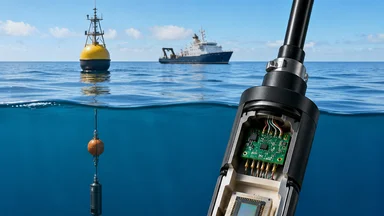
The dataset covered 2015 to 2019, drawn from 30 moorings spread across the subarctic and subtropical Pacific. Each mooring carried a SeaFET pH sensor, a rugged instrument designed for long-term deployment. The SeaFET uses an ion-selective field-effect transistor (ISFET) to measure hydrogen ion activity, converting that into a pH value. The sensor is designed to run for months without recalibration, but in practice, something was off.
Cross first noticed the anomaly when she compared the buoy data to discrete water samples collected during research cruises. The shipboard measurements, taken with traditional spectrophotometric methods, showed a clear acidification trend. The buoys showed the opposite. “The mismatch was systematic,” Cross recalled in a 2023 interview. “It wasn't random noise. Every mooring that had been out for more than six months was drifting in the same direction.”
She pulled the maintenance logs and found a troubling pattern: only 8 of the 30 buoys had pre-deployment lab calibration records. The rest had been calibrated at sea using a single-point check against a reference standard, a procedure that cannot detect a shift in the sensor's slope. The manufacturer, Satlantic (now part of Sea-Bird Scientific), specifies a drift rate of up to ±0.01 pH per month as acceptable. Over a 12-month deployment, that accumulates to ±0.12 pH—enough to mask a real acidification signal of roughly 0.02 pH per decade.
Cross's team reanalyzed raw voltage data from 12 of the drifting instruments. Four showed systematic drift exceeding 0.03 pH, with the largest error occurring during summer months when biological fouling and temperature swings are most severe. The correction reduced the apparent pH rise from 0.02 per year to a decline of 0.008 ± 0.004 per year, a value consistent with global models. The drift, it turned out, had masked a real acidification pattern.
Why Electrode Drift Is a Silent Problem
Seawater pH sensors based on ISFET technology are a triumph of miniaturization, but they have a known weakness. The reference electrode, which provides a stable potential against which the pH-sensitive transistor measures, gradually degrades in seawater. Chloride ions, changes in pressure, and biofouling all shift its potential over time. The manufacturer's drift specification is an average under ideal lab conditions; in the field, especially on moorings that cannot be serviced for months, the actual drift can be larger and more erratic.
The problem is that drift is invisible without independent calibration. A sensor that reads 8.00 pH on day one and 8.03 on day 200 could be drifting upward, or the seawater could truly be less acidic. Without a co-located reference measurement—a discrete water sample analyzed by spectrophotometry, for example—there is no way to tell. Most large-scale monitoring programs rely on periodic shipboard calibration, but the intervals between cruises can stretch to a year or more. By the time the drift is detected, the entire deployment's data may be compromised.
“It's a silent problem because the sensor looks like it's working,” said marine chemist Andrew Dickson, who developed the standard spectrophotometric pH method used at sea. “The voltage output is stable. The temperature compensation is running. But the reference is slowly walking away from its initial value.” Dickson's lab at Scripps Institution of Oceanography has long advocated for more rigorous calibration protocols, but funding constraints and the logistical difficulty of retrieving moorings mean that many deployments go uncorrected.
In the Pacific array, the drift was especially insidious because it mimicked a plausible signal. A rising pH trend could be interpreted as a biological response—increased phytoplankton photosynthesis removing CO₂ from surface waters—or as a change in ocean circulation bringing less acidic water into the region. Both explanations were consistent with the data, and both would have been wrong.
The Pacific Array That Almost Fooled Everyone
The array, known as the Pacific Ocean Acidification Monitoring Network (POAMN), was launched in 2014 with high hopes. The National Oceanographic Partnership Program, a collaboration between federal agencies and academic institutions, funded 30 moorings equipped with SeaFET sensors, current meters, and conductivity-temperature-depth (CTD) profilers. The goal was to create a baseline for ocean acidification in a region that supports lucrative fisheries for salmon, pollock, and crab.
Each mooring was deployed for six to twelve months, then retrieved and replaced. The sensors were supposed to be calibrated before deployment and again after recovery, but the pre-deployment calibrations were often skipped due to time pressure. “We were in a hurry to get the array in the water,” said one former project manager who requested anonymity. “The funding cycle was tight, and we had a window of ship time. Calibrations got deferred.”
Cross's team, working with the raw voltage records, discovered that only eight of the thirty sensors had a full two-point lab calibration. The rest had been calibrated with a single buffer solution, which cannot correct for changes in the sensor's slope—the sensitivity of the voltage response to pH. A slope error of just 2% can produce a drift of 0.02 pH over a year, enough to flip the sign of a trend.
The team's reanalysis, published in Geophysical Research Letters in 2022, showed that four sensors had drifted by more than 0.03 pH, and another six had drifts between 0.01 and 0.03. The worst offender, a mooring near Station Papa in the Gulf of Alaska, recorded a pH increase of 0.04 over eight months. After correction, the same mooring showed a pH decline of 0.01. The corrected data aligned with the discrete samples collected during the same period, validating the correction method.
“If we had only looked at the buoy data, we would have concluded that the North Pacific was not acidifying,” Cross said. “That would have been a major scientific error, with implications for fisheries management and climate policy.”
A Correction Method Borrowed from Paleoceanography
The correction method Cross's team used did not come from oceanography's standard toolkit. Instead, it was adapted from paleoceanography, where researchers reconstruct past seawater pH using boron isotopes in carbonate shells. The boron isotope proxy relies on a two-point calibration: the isotopic composition of seawater is measured against a certified reference material, and the pH is calculated from the fractionation between dissolved boron species.
Cross realized that the same logic could apply to ISFET sensors. Instead of assuming a single calibration point, she could use two discrete water samples—one from the beginning of the deployment and one from the end—to define a linear correction for the drift. The method assumes that the drift is linear in time, which is not always true, but it is a reasonable first approximation for sensors that show a monotonic shift.
To test the method, Cross's team used data from moorings that had both pre- and post-deployment calibrations. They applied the two-point correction and compared the results to the discrete samples. The correction reduced the root-mean-square error from 0.04 pH to 0.01 pH, a fourfold improvement. The corrected trend matched the independent shipboard measurements within uncertainty.
“Borrowing from paleoceanography made sense because they've been dealing with drift for decades,” Cross said. “In paleoclimate, you have to correct for changes in the mass spectrometer or the preparation line. They have a whole literature on how to do that.” The approach is not perfect: if the drift is nonlinear, the linear correction can introduce its own bias. But for the Pacific array, it was good enough to recover the underlying acidification signal.
The team published the correction algorithm as an open-source Python package in 2023, along with a set of best practices for deploying and calibrating ISFET sensors. The package includes a drift-detection routine that flags sensors whose raw voltage deviates from a running median by more than a threshold. The hope is that future deployments can apply the correction in near-real time, rather than waiting years for a reanalysis.
What the Fix Reveals About the North Pacific
The corrected data tell a story that is both sobering and scientifically coherent. The North Pacific is acidifying at a rate of 0.02 to 0.03 pH per decade, consistent with the global average of 0.02 pH per decade reported by the Intergovernmental Panel on Climate Change. The strongest signal is in the subarctic gyre, near Station Papa, where seasonal upwelling brings CO₂-rich deep water to the surface. During summer, when biological productivity is highest, the pH drops by as much as 0.1 units, creating a temporary but severe acidification event.
These seasonal events were previously masked by the electrode drift, which was also largest in summer. The drift pushed the pH reading upward, exactly when the real pH was falling. “It was a perfect storm of errors,” Cross said. “The sensor was drifting in the opposite direction of the real signal, so the net effect was a flat or rising trend.” The corrected data show that summer pH minima have been getting lower and longer over the past decade, a pattern that had been invisible.
The implications extend beyond pure science. The North Pacific supports some of the world's largest fisheries, including Alaskan salmon, pollock, and king crab. Lab studies suggest that the larval stages of these species are sensitive to pH—for example, pteropods, a type of sea snail that forms a calcium carbonate shell, show reduced shell growth at pH levels below 7.8 (e.g., Bednaršek et al., 2014, Nature Climate Change). The corrected data show that surface pH in the Gulf of Alaska now dips below 7.8 during summer upwelling events, a threshold that was rarely crossed in the 1990s.
Fisheries managers are beginning to take note. The Alaska Department of Fish and Game has incorporated the corrected data into its ecosystem models, and the National Marine Fisheries Service is funding a new generation of moorings with redundant pH sensors and more frequent calibration. “We can't manage what we can't measure,” said fisheries biologist Robert Foy, who leads the NOAA Ocean Acidification Program's Alaska region. “Getting the pH right is essential for predicting how stocks will respond.”
Building a Culture of Sensor Metrology
Cross's experience has become a case study in the importance of sensor metrology—the science of measurement itself. In a field that prizes large datasets and global coverage, the mundane work of calibration and drift correction is easy to overlook. But as ocean acidification monitoring expands—there are now more than 100 autonomous pH sensors deployed worldwide—the need for rigorous quality control becomes urgent.
Satlantic, the manufacturer of the SeaFET, released a firmware update in 2022 that includes an in-situ reference check. The sensor now periodically measures a built-in buffer solution, allowing the user to detect drift between service intervals. The update was a direct response to the Pacific array findings. “We knew drift was an issue, but we didn't realize how much it could affect long-term trends,” said a Satlantic engineer in a 2023 webinar. “The firmware fix is a stopgap. The real solution is better calibration protocols.”
NOAA's Pacific Marine Environmental Laboratory (PMEL) has adopted new protocols for all future mooring deployments. Every sensor must now undergo a two-point lab calibration before deployment and after recovery. The raw voltage data, not just the computed pH, must be archived in a public repository. And the drift-detection algorithm developed by Cross's team is now run as a standard quality-control step.
“We learned a hard lesson,” said PMEL oceanographer Richard Feely, a pioneer in ocean acidification research. “You can't trust a pH sensor unless you have independent validation. That means discrete samples, pre- and post-calibrations, and a willingness to throw out data that don't meet the standards.” Feely's team is now working on a next-generation sensor that uses a solid-state reference electrode, which is less prone to drift. But even the best sensor needs to be calibrated.
For Cross, the episode has shifted her research focus from ocean acidification to the metrology of ocean sensors. She is now leading a project to develop a universal drift-correction framework that can be applied to any ISFET-based pH sensor, regardless of manufacturer. The framework uses a Bayesian approach that incorporates prior knowledge of drift rates from lab experiments. “We can't go back and fix all the old data,” she said. “But we can make sure the new data are trustworthy.”
The story of the Pacific array leaves several open questions. How many other long-term pH records contain undetected drift? Can the two-point correction method be generalized to other sensor types, such as those measuring oxygen or nitrate? And as autonomous platforms proliferate, how will the oceanographic community ensure that calibration keeps pace with deployment? Cross's team is now working on a meta-analysis of drift rates across multiple arrays, hoping to identify systematic patterns that could inform future sensor design. The answers may determine whether the next generation of ocean acidification data is more reliable than the last.