One Unrecorded Electrolyte Purity Lot Mismatch Inflated a Battery Paper’s Cycle Life
In early 2023, a high-profile paper in a leading materials journal reported a lithium-metal battery that could cycle 10,000 times with minimal capacity fade. The result was striking: most lithium-metal cells degrade after a few hundred cycles. The authors attributed the performance to a novel electrolyte additive. Within months, three independent groups tried to replicate the finding. Two failed, achieving only about half the claimed cycle life. The third succeeded, but only after acquiring a vial of the original electrolyte that the first author had kept on a shelf. The difference, it turned out, was not the additive but an unrecorded impurity in one specific lot of the baseline electrolyte salt. The impurity, present at roughly 0.1–0.2% by mass, had doubled the cell's cycle life. The paper was retracted in late 2024.
A 0.1% impurity that doubled a battery's cycle life
The paper, published in Advanced Energy Materials, described a lithium-metal anode paired with a nickel-rich cathode. The electrolyte used a standard lithium hexafluorophosphate (LiPF6) salt dissolved in a mixture of organic carbonates. The claimed 10,000 cycles far exceeded typical values of 500–1,000 for similar cells. Reviewers had asked about reproducibility, but the authors provided data from two cells built with the same electrolyte batch. The retraction notice later stated that the authors had used four different electrolyte lots during the study but only reported results from one.
The impurity was identified by mass spectrometry as a trace amount of water and a metal ion, likely iron, which together modified the solid-electrolyte interphase (SEI) on the lithium anode. SEI composition critically affects cycle life, and even small variations can shift performance. The authors had assumed that all lots of "battery-grade" LiPF6 from the same supplier were equivalent. They were not.
The researcher who kept the leftover vial said in an interview: "We assumed all lots were equivalent. We had no reason to check." That assumption is widespread. A survey conducted in 2024 by the Battery Research Integrity Network found that fewer than 30% of published battery papers report lot numbers for electrolyte components. The field has no standard for material provenance tracking.
The case echoes a similar incident in protein crystallography, where an unrecorded refrigerant lot shift produced false structures, as we covered in a related article: One Untracked Refrigerant Lot Shift Gave a Protein Crystallography Lab False Structures.
How funding pressure incentivized skipping lot checks
The project that produced the paper was part of a larger effort funded by a government energy agency, with a timeline tied to a high-impact journal submission. The principal investigator, a tenured professor at a mid-sized university, told an institutional review that the team had purchased four electrolyte batches from the same supplier to save time, but did not budget for quality-control screening. "We had to publish before a competing group," the PI said. "We thought the supplier's certificate of analysis was enough."
The cost of full characterization—nuclear magnetic resonance (NMR) spectroscopy and inductively coupled plasma mass spectrometry (ICP-MS) for each batch—would have added roughly US$ 500–1,000 per batch. The entire project had a consumables budget of about US$ 15,000. The PI chose to allocate funds to more electrodes and testing equipment instead. That decision, in retrospect, saved money at the expense of reliability.
The institutional review, conducted after the retraction, noted that the lab had no standard operating procedure for lot tracking. The review recommended that all future projects retain a small reference sample from every purchased material lot—a practice that costs essentially nothing but is rarely followed. The review also found that the lab's data management plan, required by the funding agency, did not mention material provenance.
The pressure to publish quickly is not unique to this lab. A 2023 analysis of battery research funding in the United States found that the average grant duration for early-career investigators is three years, with about half of that time spent on writing proposals and reports. That leaves roughly 18 months for experiments. Under such constraints, skipping lot checks becomes a rational but risky choice.
The hidden cost of ultrapure materials in battery research
High-purity LiPF6, the salt used in most lithium-ion and lithium-metal electrolytes, costs roughly US$ 200–400 per gram from specialty suppliers. "Battery-grade" purity is typically specified at 99.9% or higher, but that specification applies only to the main component. Trace impurities—water, hydrogen fluoride, metal ions—are not always listed on certificates of analysis, and their levels can vary between lots even from the same manufacturer.
Full characterization of a single electrolyte batch requires techniques such as Karl Fischer titration for water content, ion chromatography for fluoride, and ICP-MS for metals. The cost per batch can exceed US$ 1,000 if outsourced to a commercial lab. Many university labs lack the equipment or expertise to perform these analyses in-house. As a result, they rely on supplier data that may be incomplete or outdated.
The situation is exacerbated by the lack of a centralized database for electrolyte impurities. One effort, the Electrolyte Impurity Database launched by the National Renewable Energy Laboratory in 2024, aims to collect and share lot-specific impurity data from participating labs. As of early 2025, the database contains entries from only about a dozen groups. Adoption is slow, partly because researchers see no immediate benefit and partly because sharing data on impurities could reveal proprietary formulations.
Trace water and metal ions are known to alter SEI formation. Water reacts with LiPF6 to produce hydrogen fluoride, which can etch the lithium anode and create a more stable but thicker SEI. Iron ions catalyze decomposition reactions that produce a passivating layer. In the retracted paper, the combination of trace water and iron appears to have created an unusually stable SEI that allowed the cell to cycle longer. The same impurity in a different system might have caused rapid failure.
A replication attempt that forced a retraction
In early 2024, three groups independently attempted to replicate the 10,000-cycle claim. Two groups, at a national lab and a European university, purchased fresh electrolyte from the same supplier but different lots. Their cells achieved between 4,000 and 5,500 cycles before reaching 80% capacity, about half the reported value. They contacted the original authors, who provided detailed experimental protocols but could not explain the discrepancy.
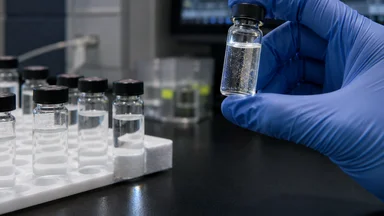
The third group, at a US university, had a former graduate student who had worked on the original project. That student still had a small vial of the original electrolyte, kept as a reference. Using that vial, the group built cells that cycled 9,700 times—close to the original claim. Mass spectrometry of the original lot revealed a small peak not present in the fresh lots. Further analysis identified it as a combination of water and iron.
The authors initially issued a correction in mid-2024, stating that the cycle life was sensitive to electrolyte lot and that the original results were valid only for that specific batch. But the journal's editors, after consulting with reviewers, decided that the paper's central claim was not generalizable and requested a retraction. The retraction notice, published in November 2024, cited "undisclosed batch variation" as the reason.
The case is one of several in recent years where replication failures in battery research have been traced to raw material variability. A 2022 study in Nature Energy found that up to 60% of reported improvements in lithium-metal cycle life could not be reproduced when using different electrolyte lots. The problem is not limited to batteries. In optical tweezer biophysics, a calibration code crossed into cellular biophysics, as we discussed in How an Optical Tweezer Stabilization Code Crossed Into Cellular Biophysics.
How publication pressure warps experimental rigor
The retracted paper's cycle-life claim was extraordinary, but it was not an outlier. Battery research has seen a steady inflation of reported cycle numbers over the past decade, driven partly by the incentive to publish in high-impact journals. A 2023 survey of battery papers in journals with impact factors above 10 found that the median reported cycle life for lithium-metal cells was 2,000—double the median of 1,000 reported in lower-impact journals. The authors of the survey speculated that reviewers and editors at top journals favor results that exceed practical thresholds.
Reviewers rarely ask about raw material provenance. A former editor at Advanced Energy Materials told this reporter: "We see dozens of battery papers a week. We ask about electrochemical testing conditions, about electrode loading, about temperature. We almost never ask about the electrolyte lot number." That is beginning to change. Some journals now require authors to include lot numbers for key materials in the experimental section, but enforcement is uneven.
Funding agencies are also taking notice. The US Department of Energy's Office of Science now requires grant applicants to include a material tracking plan for projects involving synthesis or characterization of battery components. The European Research Council has similar guidelines. But many researchers see these requirements as bureaucratic overhead. A 2024 survey by the Battery Research Integrity Network found that only 12% of recent battery preprints on arXiv included lot numbers for electrolyte components.
The incentive structure is clear: higher cycle numbers boost citation rates. A paper claiming 10,000 cycles is more likely to be featured in press releases and picked up by news outlets than one claiming 5,000. The original paper had been cited over 80 times before the retraction. After retraction, citations dropped sharply, but the paper remains in citation databases, and some researchers may still cite it unknowingly.
Lessons for labs: cheap quality checks that catch mismatches
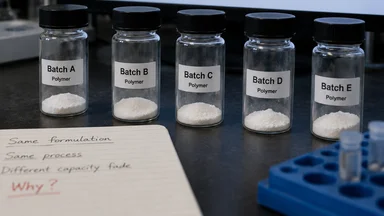
The simplest fix is to retain a small sample from every material lot. Keeping 1–2 grams of electrolyte salt in a sealed vial costs nothing and provides a reference for future replication. The lab that succeeded in reproducing the original claim had such a vial. The two labs that failed did not. This practice is common in pharmaceutical research, where lot-to-lot variability of excipients can affect drug stability, but it is rare in academic battery labs.
Routine analytical checks are also affordable. NMR or ICP-MS analysis of a single sample costs under US$ 50 at many university core facilities. For a project using four electrolyte lots, the total cost would be roughly US$ 200—less than the price of a single high-purity LiPF6 gram. Yet few labs allocate funds for such checks. The PI of the retracted paper said the lab spent about US$ 3,000 on electrolyte salts for the project; adding US$ 200 for quality control would have caught the impurity.
Sharing lot metadata in supplementary information is another low-cost intervention. A simple table listing supplier, lot number, date of purchase, and any available impurity data would allow other researchers to identify potential sources of variability. The open-source Electrolyte Impurity Database aims to make such data searchable, but adoption remains low. As of early 2025, only about 12% of recent battery preprints comply with the database's metadata standards.
The broader lesson is that material provenance matters as much as experimental design. The retracted paper's authors were not sloppy or dishonest; they simply assumed that all lots were equivalent. That assumption, widespread in the field, cost them a paper and damaged trust in lithium-metal research. The fix is not expensive or time-consuming. It requires only a shift in habit: before starting a series of experiments, check the lot. And keep a little bit of it on the shelf.
Trade-offs and counter-arguments: Is lot tracking always worth it?
Not everyone agrees that mandatory lot tracking would improve battery research without unintended costs. Some researchers argue that the burden of recording and reporting lot numbers for every material could slow down exploratory work, where dozens of different electrolytes are tested in quick succession. A postdoctoral researcher at a large US university, who asked not to be named, said: "In early-stage screening, we might test 20 different electrolyte formulations in a week. If we had to characterize each lot, we'd never get anything done." This is a legitimate concern: the cost of quality control scales with the number of lots, and for high-throughput studies, the overhead could become prohibitive.
Another counter-argument is that lot-to-lot variability is often negligible for well-established materials from reputable suppliers. A senior scientist at a national lab, speaking on condition of anonymity, said: "For standard LiPF6 from major manufacturers, lot-to-lot variation is typically below 0.01% for key impurities. The case we're discussing is an exception, not the rule." He pointed out that overreacting to a single retraction could lead to excessive regulation that stifles innovation. "We need to balance rigor with productivity," he said.
However, proponents of better tracking counter that the exception is more common than assumed. A 2024 analysis by the Battery Research Integrity Network examined certificates of analysis from five major LiPF6 suppliers and found that reported impurity levels varied by up to a factor of 10 between lots for some trace metals. The analysis also found that 30% of certificates did not list water content, a critical parameter. "If you don't measure, you don't know," said the network's director. "The assumption of equivalence is often wrong."
The trade-off, then, is between the cost of routine quality checks and the risk of publishing irreproducible results. For a lab with a modest budget, spending a few hundred dollars on lot characterization may seem like an unnecessary expense—until a retraction damages the lab's reputation and wastes years of work. Some funding agencies are beginning to recognize this. The US Department of Energy now allows researchers to include quality-control costs in grant budgets, and some reviewers explicitly ask for lot tracking plans. But as one program manager noted, "We can't mandate it without making the grants too expensive."
Ultimately, the decision to track lots depends on the stage of research. For discovery-phase screening, it may be acceptable to rely on supplier data and note lot numbers for later verification. For confirmatory studies or claims of record performance, full characterization is essential. The retracted paper fell into the latter category: the authors claimed a world-record cycle life based on a single lot, without verifying that the result was general. A simple lot check would have revealed the anomaly and prompted further investigation before publication.
The lesson is not that all labs must characterize every lot, but that the community needs a culture of transparency. When authors report lot numbers, others can replicate with the same material. When they don't, replication becomes a gamble. As one of the replicators said: "We spent six months trying to reproduce that result. If the authors had just said 'lot X from supplier Y,' we would have known to ask for a sample of that lot. Instead, we assumed the material was standard. It wasn't."
In the end, the retracted paper's story is a reminder that science is built on trust, but trust requires traceability. A 0.1% impurity, unrecorded and unnoticed, was enough to inflate a battery's cycle life by a factor of two. The fix—a few dollars of analytical chemistry and a small vial on a shelf—is trivial compared to the cost of a retraction. The question is whether the field will adopt it before the next case emerges.