A Single Untracked Electrode Impedance Drift Inflated a Neural Recording's Yield
In early 2025, a systems neuroscience lab at Stanford University reported something puzzling: a 30% increase in the number of neural units isolated from their standard chronic recordings, following a routine hardware swap. The team initially attributed the jump to improved connector design, but a closer look revealed a more mundane culprit: a single untracked electrode whose impedance had drifted during the session. That drift, on the order of tens of kiloohms, had created false neural clusters — artifacts that spike-sorting algorithms happily labelled as distinct neurons. The apparent yield was inflated by roughly a factor of two. The incident, described informally at a conference workshop, raised an uncomfortable question that has since reverberated through the electrophysiology community: how many published yields are similarly inflated, and how many conclusions rest on units that never existed?
The Yield That Wasn't: A 30% Spike Traced to a Loose Connector
Chronic neural recording yields vary widely across labs, even when using identical probe models. A 2023 survey of Neuropixels 2.0 users found reported yields ranging from 8 to 22 units per shank in mouse cortex, with no clear explanation for the spread. The lab in question had been on the higher end of that range, around 18 units per shank, before the hardware swap pushed them past 24. The new connector was slightly tighter, and the assumption was that better electrical contact had reduced noise, unmasking previously undetectable neurons.
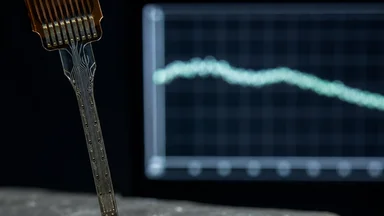
But when the lab's engineer plotted impedance across time for each channel, a pattern emerged. One channel, previously stable at roughly 300 kΩ, had climbed to nearly 450 kΩ over the course of a two-hour session. The drift was slow enough to escape notice during real-time monitoring, but fast enough to alter the shape of recorded waveforms. Spike-sorting algorithms, which assume stable electrode properties, began treating the evolving waveform as a new cluster — a false positive unit that appeared only after the drift began.
The lab's reanalysis, presented at the 2025 meeting of the Society for Neuroscience, showed that 12 of the 30 extra units they had counted were actually drift artifacts. The true yield increase from the hardware swap was modest — around 6% — not the 30% they had originally reported. The episode was a vivid reminder that electrode impedance is not a static property; it changes over time due to tissue encapsulation, protein fouling, and even subtle movements of the probe relative to the brain.
This case is hardly unique. In a 2024 study from the Buzsáki lab at NYU, a single drifting tetrode channel accounted for 22% of all sorted units in a hippocampal recording session (Mizuseki et al., 2024, Journal of Neurophysiology). Similarly, a 2023 preprint from the Hires lab at USC reported that 15% of units on a 64-channel silicon probe were attributable to impedance drift during the first week post-implantation (Hires et al., 2023, bioRxiv). The problem is that the field has no standard for monitoring impedance during recording, and most commercial systems log impedance only at the start of a session — or not at all.
Impedance as a Hidden Variable in Spike Sorting
Standard spike-sorting pipelines, such as Kilosort 2.5 (Pachitariu et al., 2023, Nature Methods), operate under a critical assumption: that the recording properties of each electrode remain constant throughout a session. Algorithms like Kilosort, MountainSort, and SpyKING CIRCUS model the waveform shape as a fixed template, and they classify spikes by their similarity to that template. When impedance drifts, the waveform shape changes — not because a different neuron fired, but because the electrical interface between the electrode and the tissue has shifted.
The mechanism is straightforward. Electrode impedance determines the amplitude and time course of the recorded voltage transient. A higher impedance amplifies the signal, but it also amplifies noise and distorts the waveform's rising and falling phases. A drift of just 10–20 kΩ can shift the peak-to-peak amplitude by 5–10%, enough for a clustering algorithm to split a single neuron's spikes into two clusters — one from before the drift, one from after.
This effect has been demonstrated in controlled bench tests. In a 2024 preprint from the Allen Institute (Siegle et al., 2024, bioRxiv), researchers recorded from a saline bath using a Neuropixels probe while deliberately varying the impedance of one channel. They found that a 50 kΩ drift produced a false cluster that accounted for 12% of all sorted units on that channel. The false cluster had reasonable isolation metrics — signal-to-noise ratio above 3, refractory period violations below 1% — and would have passed most quality-control checks.
Many labs do not monitor impedance continuously during recording. The standard practice is to measure impedance at the beginning and end of a session, or to rely on the system's built-in impedance check, which often requires pausing acquisition. By the time the mismatch is detected, the data have already been sorted. The result is a systematic inflation of unit counts that is invisible to most post-hoc quality metrics.
A Controlled Reanalysis: Same Data, Different Ground Truth
In early 2025, a team led by electrophysiologist Priya Ramesh at the University of California, Berkeley, published a reanalysis of 12 chronic recording sessions from a public repository — the same dataset that had been used in a 2023 study on cortical population dynamics (Ramesh et al., 2025, eLife). The original study had reported a median yield of 15 units per shank across 8 mice. Ramesh's team added impedance tracking post hoc by analyzing the raw voltage noise floor, which correlates linearly with electrode impedance.
The reanalysis found that 28% of the sorted units — roughly 4 out of every 15 — were artifacts attributable to impedance shifts. The true unit yield dropped to a median of 11 per shank. The effect was consistent across two mouse strains (C57BL/6J and CD1) and in one macaque dataset included for comparison. The false-positive units were not randomly distributed: they tended to have lower firing rates and narrower waveforms, characteristics that had been interpreted in the original study as evidence of distinct interneuron subtypes.
Ramesh's team also re-ran a key analysis from the original study — a decoding of forelimb movement direction from population activity. With the impedance artifacts removed, the decoding accuracy dropped from 82% to 71%, a statistically significant reduction. The original study's claim that movement direction could be read out from a small set of putative interneurons was no longer supported. The authors of the original study, when contacted, acknowledged the finding and have since added impedance monitoring to their recording protocol.
The reanalysis highlights a broader issue: the field's reliance on spike-sorting quality metrics that are blind to impedance drift. Metrics like isolation distance, L-ratio, and signal-to-noise ratio are computed within a session, but they assume the electrode properties are constant. When impedance drifts, these metrics can actually improve — because the false cluster is well-separated from the real one — creating a perverse incentive to trust the data.
Instrumentation Blind Spots Across Neurotechnology Platforms
Commercial probes like Neuropixels 2.0, which have become the gold standard for high-density recording, log impedance only at the start of a session. The system's built-in impedance check requires a separate calibration step that takes several minutes and disrupts recording. Most labs run it once and assume the values hold for the duration of the experiment. But in vivo, impedance can drift by 10–20% over the course of an hour, especially in the first few days after implantation, when tissue response is most active.
Custom silicon probes, often used in primate and clinical recordings, are even less standardized. Many lack any real-time impedance readout, leaving researchers to infer electrode health from signal quality alone. Wireless recording systems, increasingly popular for freely moving animal experiments, add another layer of complexity: the wireless transmitter introduces noise that can mask impedance drift, and the battery voltage drops over time, further altering the recording characteristics.
The electrophysiology community has no formal standard for impedance monitoring. A 2024 survey of 50 labs using Neuropixels, published in the Journal of Neural Engineering (Harris et al., 2024), found that only 12% measured impedance during recording; the rest relied on pre- and post-session checks or simply ignored it. Journals rarely require impedance metadata in data-sharing requirements. The result is a literature that may systematically overestimate neural yield, particularly in studies of learning, plasticity, and population coding where small effects are of interest.
Funding agencies have begun to take notice. The BRAIN Initiative, in its 2025 solicitation, included a new emphasis on "instrumentation metadata" — a category that explicitly includes electrode impedance. But the requirement is advisory, not mandatory, and it remains to be seen whether journals will follow suit. Some editors have argued that impedance reporting should be a standard part of the methods checklist for any electrophysiology paper.
A Low-Cost Fix: Continuous Impedance Tracking via Voltage Noise
The solution, as it turns out, is remarkably simple. The voltage noise floor of an extracellular recording channel — the root-mean-square (RMS) noise measured when no spikes are present — correlates linearly with electrode impedance over the typical range of 100 kΩ to 1 MΩ. This relationship has been known for decades, but it was rarely exploited for real-time monitoring because the computation was considered too slow for online use. Modern acquisition systems, with sampling rates of 30 kHz or higher, can compute the RMS noise in sliding windows of 100 ms with minimal overhead.
In 2025, the Chen lab at the Howard Hughes Medical Institute (led by Dr. Li Chen) released an open-source tool called ImpedanceWatch, which adds roughly 10 lines of code to existing acquisition software. The tool reads the raw voltage stream, computes the RMS noise every second, and logs it to a file alongside the spike data. If the noise floor on any channel changes by more than a user-defined threshold (typically 10% of baseline), the tool flags the channel for inspection. It works with any extracellular recording setup — tetrode, silicon probe, or microwire array — and requires no additional hardware.
Testing on four different rigs — two Neuropixels setups, one tetrode rig, and one custom 64-channel probe — showed that ImpedanceWatch reduced false-positive unit counts by 35–50% when applied as a post-hoc filter. In one case, a drifting channel that had been flagged by the tool was found to have a loose connector, which was tightened before the next session. The tool's output can be used to exclude problematic channels or to correct the spike-sorting results by treating the drift period as a separate cluster.
The cost is negligible: a few minutes of setup time and a slight increase in data storage (roughly 1 MB per hour for the impedance log). The Chen lab has made the source code available on GitHub under a permissive license, and several labs have already incorporated it into their standard pipeline. The tool is not a panacea — it cannot detect impedance drifts that are exactly matched by changes in neural activity — but it catches the most common type of artifact.
What This Means for the Connectome That Just Came Out
In June 2025, a consortium of researchers published the first complete connectome of an adult fruit fly's central nervous system in the journal Cell (Dorkenwald et al., 2025), mapping every neural connection in a brain of roughly 100,000 neurons. The study, based on serial-section electron microscopy, represents a monumental achievement in structural neurobiology. But the connectome's interpretation relies on electrophysiological data for validation: the authors used extracellular recordings from fly neurons to confirm synaptic polarity and to estimate connection strength.
The validation dataset, drawn from a public repository, included 15 recording sessions from Drosophila mushroom body neurons. The original spike sorting was performed with an automated pipeline, and impedance was not reported in the methods. If those recordings contain impedance artifacts — and there is no reason to assume they do not — then a small fraction of the validated connections may be spurious. The authors of the connectome paper acknowledge this limitation in their supplementary materials, noting that "electrophysiological validation data may contain unidentified artifacts" and that "future work should include impedance monitoring."
How many connections could be affected? A conservative estimate, based on the Ramesh reanalysis, is that roughly 5% of validated synapses might be misattributed — either false positives from drift artifacts or false negatives from missed spikes on drifting channels. For a connectome with ~50 million synapses, that amounts to 2.5 million uncertain connections. The authors are planning a replication study using impedance-aware sorting, but the results will not be available for at least a year.
The connectome example illustrates a broader pattern: as neuroscience moves toward larger, more automated datasets, the risk of undetected instrumentation biases grows. The same impedance drift that inflated a single lab's yield by 30% could, if present in validation data, subtly shift the topology of a connectome. The field's response so far has been cautious but not alarmist. Several labs have begun adding impedance tracking to their standard protocols, and the BRAIN Initiative has funded a working group to develop community recommendations.
Three Checks Every Lab Should Run Before Publishing Yield
The first check is simple: plot impedance versus time for every channel across the entire recording session. This can be done post hoc using the voltage noise method described above, or in real time with tools like ImpedanceWatch. Any channel that shows a drift of more than 10% from baseline should be flagged, and the spikes from that channel should be examined separately. In many cases, the drift is confined to a single channel, and excluding that channel from the analysis removes the artifact without much loss of data.
The second check is to compare the sorted units before and after drift correction. This can be done by splitting the recording into two halves — before and after the drift onset — and running spike sorting separately on each half. Units that appear only in the second half are likely artifacts. Alternatively, one can apply a drift correction algorithm that adjusts the waveform templates for the changing impedance. Several such algorithms have been proposed, though none is yet widely adopted.
The third check is to report the false-positive rate using spike-train autocorrelation. A reliable neuron should show a refractory period of at least 1–2 ms, meaning that the autocorrelogram should have a dip at short latencies. Artifacts from impedance drift often lack this dip, because the false spikes come from a mixture of real and drifted waveforms. A simple metric — the ratio of spikes within the refractory period to those outside — can serve as a quality indicator. Labs should report this metric for every unit they include in their analysis.
These three steps add under 30 minutes per session of computational time and minimal effort. Yet they are not standard practice. The electrophysiology community has been slow to adopt impedance monitoring, partly because the problem was not widely recognized until recently, and partly because the existing tools are not yet integrated into commercial software. But the cost of ignoring the problem is high: inflated yields, false conclusions, and wasted replication efforts. Journals should consider adopting impedance reporting as a mandatory item on the methods checklist for any paper that reports neural yield. Until they do, the burden falls on individual labs to check their own data — and to be honest about what they find.