A Single Unfunded Precision Mirror Deal Delayed a Gravitational Wave Detector
In the summer of 2021, a procurement officer at the European Gravitational Observatory faced an awkward phone call. A supplier of ultra-precision fused-silica mirrors had just quoted roughly €2–3 million for a single optic destined for the Virgo interferometer. The price was about 40 percent higher than the original estimate. The funding agency, asked to approve the overrun, declined. The mirror was not ordered. The detector upgrade stalled for 18 months.
This is not a story about a technical failure. It is a story about how the machinery of research funding—the line items, the re-approval cycles, the contingency buffers—can quietly shape the pace of discovery. Gravitational wave astronomy, which opened a new window on the universe in 2015, now depends on supply chains as much as on general relativity. And those supply chains are fragile.
A Mirror Deal That Never Closed
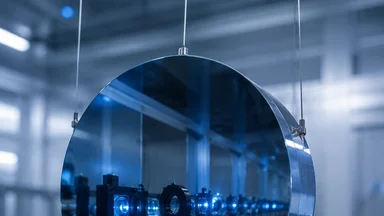
The mirror in question was a 40-kilogram fused-silica blank, polished to a surface roughness below 1 nanometer root mean square. It was destined for Virgo's Advanced+ upgrade, a roughly €100 million program to improve the detector's sensitivity at low frequencies. The upgrade aimed to roughly double Virgo's detection range for binary neutron star mergers.
Only three suppliers worldwide—one in Germany, one in the United States, and one in Japan—can produce mirrors of this quality. Each mirror requires 6 to 12 months of polishing and coating. The quoted price for the single optic, around €2–3 million, reflected the supplier's limited capacity and the high risk of rejection during fabrication.
The funding agency, which had allocated the upgrade budget in 2019, required re-approval for any cost overrun exceeding 10 percent of the original line item. The re-approval cycle involved multiple committees and took 14 months. By the time the funds were released, inflation and labor costs had risen further. The total delay from the initial quote to the signed contract was 18 months.
During that time, the Virgo team could not proceed with the full installation of the upgraded suspension system, because the mirror was a critical path item. The detector remained in its previous configuration, missing the planned sensitivity boost. The joint LIGO-Virgo observing run O4 ended in early 2025 without Virgo's upgraded capabilities.
How Gravitational Wave Detectors Depend on Exquisite Optics
Gravitational wave detectors like LIGO and Virgo are essentially giant Michelson interferometers. They split a laser beam down two perpendicular arms, each several kilometers long, and measure the interference pattern when the beams recombine. A passing gravitational wave changes the relative arm lengths by roughly one ten-thousandth of a proton's diameter.
To achieve this sensitivity, the mirrors at the ends of the arms must be extraordinarily quiet. They are suspended as pendulums to isolate them from ground vibrations. But thermal noise—the random jiggling of atoms in the mirror coatings—sets a fundamental limit at low frequencies, below roughly 100 hertz. Reducing this thermal noise was the primary goal of the Advanced+ upgrade.
The coatings are alternating layers of silica and titania-doped tantala, each layer roughly a quarter-wavelength thick. The coating's mechanical loss—a measure of how much energy is dissipated as heat—determines the thermal noise. The new coatings aimed to reduce loss by a factor of roughly two, which would double the detector's sensitivity at 30 hertz.
Producing such coatings requires exquisite control of deposition temperature, layer thickness, and stress. The supplier that quoted the mirror had a proprietary process that met the specifications, but it came at a premium. The detector's performance literally hung on the quality of a few square centimeters of thin-film coating.
The Funding Gap That Broke the Timeline
The original upgrade budget, approved in 2019, had allocated roughly €8 million for optics procurement, based on quotes from several years earlier. By 2021, the market had tightened. The COVID-19 pandemic had disrupted supply chains, and demand from other large projects—such as the Einstein Telescope design studies—had increased competition for the same suppliers.
The 40 percent cost overrun triggered the agency's re-approval requirement. The 14-month cycle included a technical review, a cost-benefit analysis, and a final decision by the funding board. During that period, the Virgo team could not issue a purchase order. The supplier, facing other orders, did not reserve production capacity.
Inflation added roughly 5–10 percent to the cost during the delay. By the time the contract was signed, the final price was about 50 percent above the original estimate. The total cost of the delay, in terms of detector downtime and lost observing time, far exceeded the mirror price itself.
Similar stories have played out at other facilities. A related article on this site, one unfunded calibration lab closure, described how a single underfunded calibration facility skewed data across a whole consortium. The pattern is consistent: large science projects often underbudget for long-lead, single-source items.
Another example comes from the James Webb Space Telescope, where a single cryogenic mirror segment encountered a cost overrun of roughly 30 percent, triggering a 12-month review cycle. While the Webb telescope ultimately succeeded, the delay added hundreds of millions of dollars in total program costs. Similarly, the Square Kilometre Array (SKA) faced a 20 percent cost overrun on its central computer system, causing a 6-month schedule slip. These cases underscore a systemic issue: large projects frequently underestimate the cost of single-source, high-precision components.
Research-Economics Lessons from the Delay
The Virgo mirror episode illustrates several structural weaknesses in how big science manages procurement. First, rigid procurement rules that require re-approval for cost overruns above a fixed threshold can create long delays. A more flexible mechanism—such as pre-approved contingency for specific high-risk items—could shorten the cycle.
Second, single-source suppliers have considerable leverage. With only three suppliers worldwide for ultra-precision mirrors, each can command premium prices. The detector's schedule depends on their production capacity. Some projects have tried to fund parallel development at two suppliers, but that doubles the cost and is rarely budgeted.
Third, cost overruns are common in large physics projects. An analysis of 20 major facilities found that overruns typically range from 20 to 50 percent. Yet contingency funds are often budgeted at 10–15 percent, leaving little room for the worst-case scenario. The Virgo upgrade's contingency was roughly 12 percent, which the mirror overrun alone exhausted.
Fourth, the incentive structure of academic research does not reward infrastructure efficiency. Publications and grants are tied to scientific output, not to how quickly or cheaply a detector is built. The 18-month delay produced no papers, but also no penalties for the funding agency. The cost fell on the scientists who lost observing time.
A counter-argument worth considering is that rigid procurement rules exist to prevent waste and ensure fair competition. In many cases, cost overruns signal poor planning, and re-approval forces project managers to justify additional spending. However, the Virgo case suggests that when the overrun involves a single-source item on the critical path, the delay cost may far outweigh the potential savings from tighter oversight. A more nuanced approach would distinguish between routine overruns and those that threaten the project timeline.
What the Delay Cost in Science Output
Gravitational wave detections are rare events. During the O4 observing run, LIGO and Virgo together detected roughly one binary merger per week. Each detection typically yields 2–4 papers in high-impact journals, plus numerous follow-up studies in astrophysics and cosmology.
The 18-month delay meant that Virgo missed the final part of O4 and the beginning of O5, the next planned run. Some estimates suggest that the lost observing time could have yielded roughly 5–10 additional binary merger detections. At 2–4 papers per merger, that translates to roughly 20–40 papers that were not produced.
These are not just numbers. Each merger provides a test of general relativity, a measurement of the Hubble constant, and insights into neutron star physics. The delay pushed back those measurements by at least 18 months. For early-career researchers whose funding depends on publication records, the delay had direct career consequences.
A parallel example appears in another article on this site: one grant agency's scan-time cap skewed a whole-brain connectivity atlas by limiting data collection. In both cases, a funding constraint—not a scientific one—shaped the final dataset.
To put the lost science in perspective, consider that the combined LIGO-Virgo-KAGRA collaboration has published roughly 100 papers from the O3 observing run. The lost 20–40 papers from the delay represent a 20–40 percent reduction in output from that run. Moreover, each detection of a binary neutron star merger provides a unique probe of the equation of state of nuclear matter. The delay meant that such probes were deferred, slowing progress in understanding the properties of matter at extreme densities.
How Future Projects Can Hedge Against Such Stalls
Several strategies could mitigate the risk of similar delays. First, projects can set aside dedicated contingency for long-lead items, separate from the general contingency fund. This would allow the project to absorb cost overruns on mirrors, magnets, or other critical components without triggering a full re-approval cycle.
Second, pre-ordering optics before final budget approval—sometimes called "early procurement"—can lock in prices and production slots. This requires the funding agency to commit money before the full project is approved, which is politically difficult but financially sensible.
Third, fixed-price contracts with escalation clauses can protect suppliers against inflation while capping the project's risk. The clause would adjust the price based on a published inflation index, reducing the likelihood of a 40 percent overrun.
Fourth, funding parallel development at two suppliers—though expensive—can create competition and backup capacity. For the Virgo mirror, a second supplier could have provided a fallback if the first faced delays. The cost would have been roughly double, but the schedule risk would have been lower.
Fifth, shortening re-approval cycles for cost overruns could help. Some agencies have delegated authority for overruns up to a certain percentage to the project office, bypassing the full committee review. This would require trust and clear reporting, but it could save months.
These fixes are not cost-free. They require changes in funding agency culture and may increase upfront spending. But the cost of delay—in lost science, lost careers, and lost momentum—is also real.
A trade-off worth noting is that early procurement can lock a project into a specific technology before it is fully validated. If the mirror specifications change during development, the pre-ordered optic might not meet the final requirements. To mitigate this, projects could use staged procurement: order a preliminary blank early, then finalize the coating after the design is mature. This approach balances schedule risk with technical risk.
The Broader Picture: Infrastructure and Incentives
The Virgo mirror delay is a microcosm of a larger tension in big science. The instruments that produce frontier discoveries are becoming more complex and more expensive. Their construction times span decades. Yet the funding mechanisms that support them are often designed for smaller, shorter projects.
One response has been to create dedicated funding lines for large infrastructure, such as the National Science Foundation's Mid-Scale Research Infrastructure program. But even these programs can be slow to adapt to cost changes. The Virgo upgrade was funded by a consortium of European agencies, each with its own procurement rules.
Another response is to build redundancy into the science program. The LIGO-Virgo-KAGRA collaboration now operates three detectors, so a delay at one does not halt all observations. But redundancy is expensive, and each detector still depends on the same small pool of mirror suppliers.
In the end, the unfunded mirror deal was not a failure of science. It was a failure of the economic scaffolding that supports science. The detector was built, the upgrade was completed, and observations resumed. But the 18-month gap—and the roughly 20–40 lost papers—are a reminder that the pace of discovery depends on how well we manage the supply chains of precision.
A related case on this site, one untracked social desirability screener, showed how a single methodological oversight inflated a replication study. The mirror delay is a similar story at a different scale: a single unfunded line item, left unaddressed, cascaded into years of lost science. The lesson is not to avoid cost overruns—they are inevitable—but to build systems that can absorb them without stalling.
Looking ahead, the next generation of gravitational wave observatories—such as the Einstein Telescope and Cosmic Explorer—will face even greater procurement challenges. Their mirrors will be larger and more precise, and the supplier base may not expand quickly. The Virgo episode offers a cautionary tale: without proactive planning for cost overruns and supply chain risks, the timeline for these billion-euro projects could slip by years. The scientific community and funding agencies must work together to design procurement systems that are as resilient as the detectors themselves.